


A confessed fault is half forgiven: we do not know whether the zebra is white with black stripes or black with white stripes.
However, we know the aesthetic potential of this incomparable pattern, which is why we have given it pride of place on our rails.
Between the lines of this article, we invite you to discover many more and embark on a vertical journey through our favourite piece.

A case for stripes
In the world of clothing, pattern intrigues as much as it unsettles. Far from the calm shores of plain blues and greys, it intimidates through its presence and demands. Indeed, its geometry adds complexity to an outfit, making it both appealing and formidable.
Like an unusual colour, a distinctive cut or an original design, pattern is a decisive factor: mastered, it undeniably contributes to the success of an outfit; neglected, it can easily disrupt its harmony.
In the kingdom of colourful patterns, stripes nevertheless enjoy a special status. Vertically, they lengthen the silhouette and lend a slender charm to any outfit. More neutral than checks, lighter than houndstooth and decidedly less extravagant than leopard, they almost stand as a transition between plain fabric and pattern.
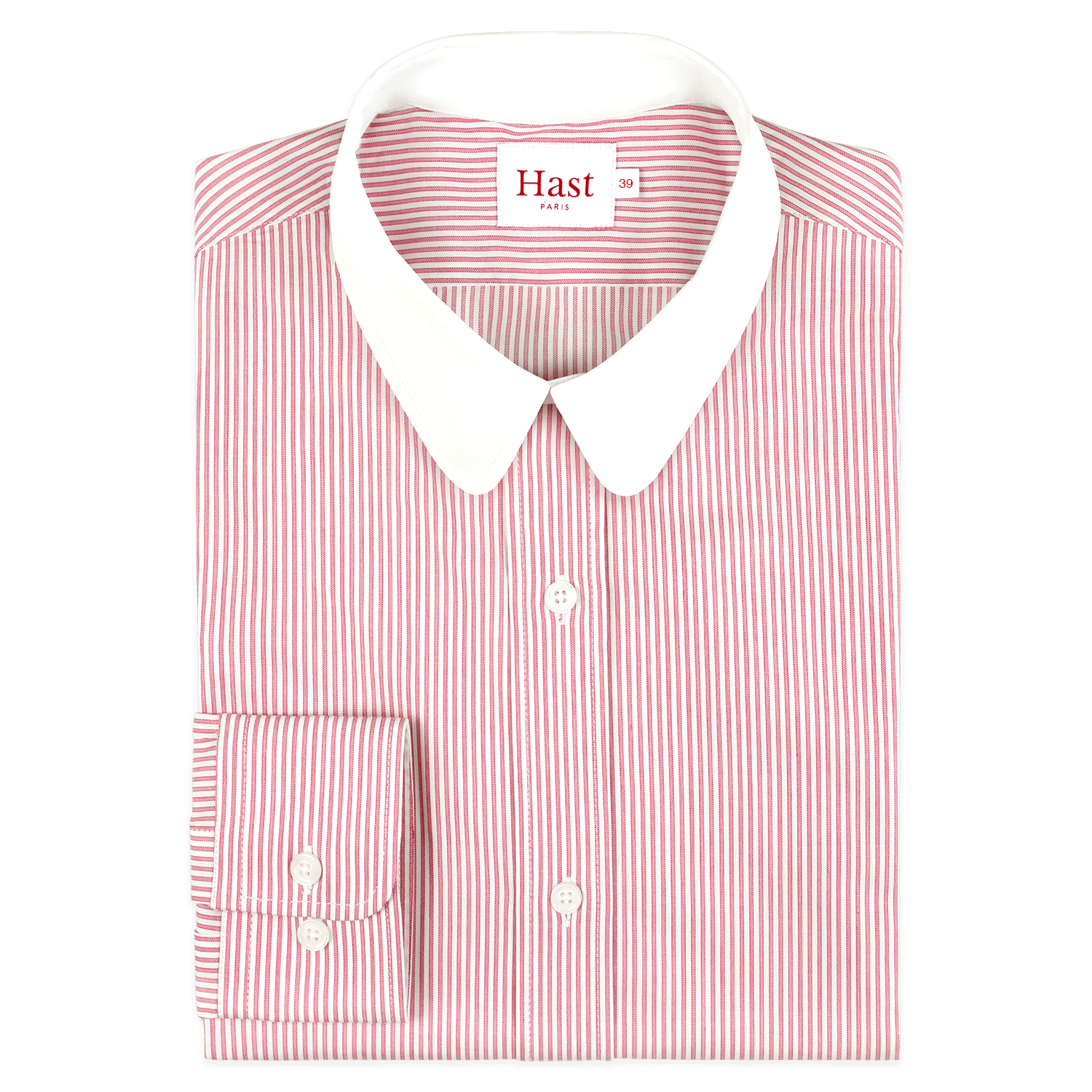
With its parallel lines, variously visible, thick and spaced, stripes subtly evoke the idea of elevation; a fine avenue for those aspiring to rise stylistically.
Stripes in all simplicity
While gingham, polka dots, chevrons and argyle may seem daunting, nothing is more approachable than a striped pattern. Simple and minimalist, it presents itself discreetly, almost timidly, bringing a modest distinction to the pieces it adorns.

Unlike certain gaudy patterns, stripes do not insist. They make no claims. They do not press their point. They simply pass by, sometimes from top to bottom, sometimes from bottom to top. More or less perceptibly. Always gracefully.
At heart, it is no coincidence that classic shirts have made it their best friend. You know what refinement thinks of showiness and self-importance, and no one will be surprised to see shirting fall for the most refined of patterns.
At Hast too, and unsurprisingly, you will find that stripes have won the favour of our formal shirts. A faithful ally of beauty, companion to good taste and favourite of formal elegance, they run across our pieces with their usual rigour and customary delicacy.
.jpg)
The different types of stripes
At this point, it should be noted that there is an infinite variety of stripes. In this matter, colour, width and spacing are the three variables at play to offer you 1,001 possibilities on a platter.
As a general rule: the closer, finer and more tone-on-tone the stripes, the more formal they are. Conversely, widely spaced, broad and contrasting stripes are better suited to casual shirts.

Without taking it literally, we have followed this principle in patterning our shirts, to the point that the most formal among them appear plain behind the subtlety of their stripes.
That said, it is not impossible to sidestep this prescription, provided you do so knowingly. Bold, conspicuous stripes, for example, were the hallmark of Wall Street style in the 80s and 90s… but not everyone can be Patrick Bateman (and thankfully so).

In short, here are the three types of striped shirts you will find on our rails:
- The most formal range. Mainly made in poplin and twill, it includes blue and white shirts, rather long and fitted, designed to be worn tucked into trousers. The stripes are fine, closely spaced and worked in simple, light colours. An excellent alternative to plain fabric, it brings a discreet note of sophistication.
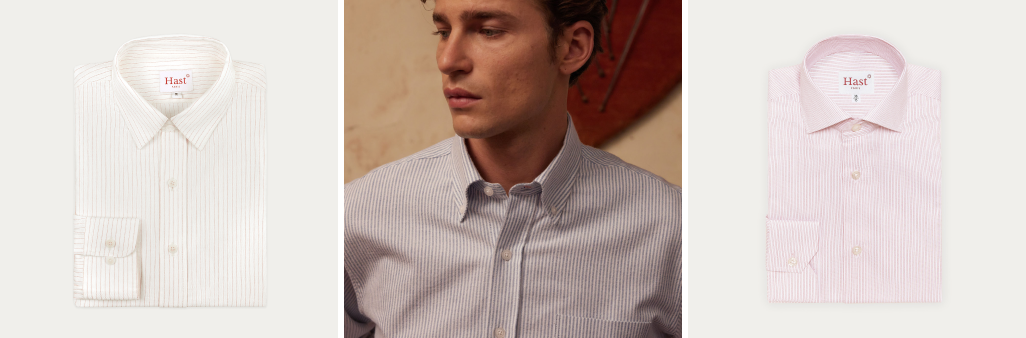
- The interte range. To be handled with care, this selection can be considered for formal or more casual outfits. Mostly made in poplin, it dares to use generous, pronounced stripes, possibly in bold colours.
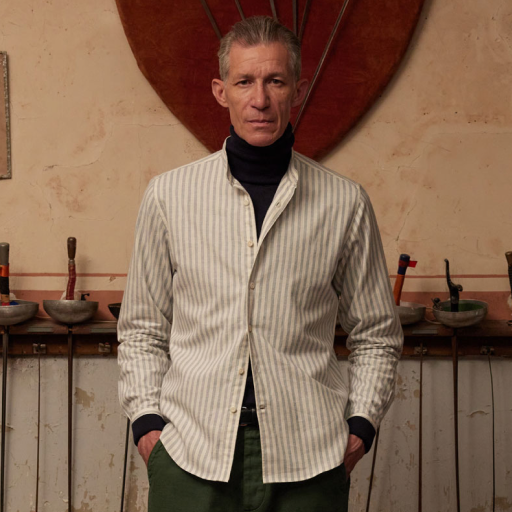
- The casual range. Let us leave poplin for more textured fabrics such as Oxford or flannel, crafted in cotton, wool or linen. Here, stripes serve fairly short, straight casual shirts, designed to be worn open over a T-shirt or tucked out of the trousers. More extravagant, the pattern expresses its full potential here.
The art of pairing a striped shirt
Choosing a striped shirt is not everything; it must also be paired properly. To guide you along this perilous path, here are three tips to avoid a misstep:
- Beware of overdoing it. The more visible and substantial they are, the more stripes give body to your outfit. We therefore recommend opting for restraint to complete the look.

- Watch the harmony of colours. As a striped shirt is at least two-coloured, it is important to keep a close eye on the chromatic balance of the rest of your outfit. By opting for analogous or complementary shades, you will automatically avoid missteps.

- Mix the registers. As you know, shirts with fine, subtle stripes are formal, while shirts with broad, demonstrative stripes evoke a casual world. Pairing the former with chinos or the latter with a suit jacket would therefore be clumsy.
We can never repeat it enough: in clothing, there is no rule that cannot be broken. Alongside these basic guidelines, we therefore offer you a fourth at no extra cost: do not hesitate to free yourself from them.

The special case of checked stripes
A particularly delightful styling device, mixing stripes is among the most surprising and effective combinations in the men’s wardrobe. This may seem strange after our warning against an excess of patterns, but it reminds us never to say never when it comes to clothes.
Unlikely but true, it is entirely possible to pair a striped shirt with a striped tie and a striped suit without looking like a human barcode. The secret? Play the diversity card.
If you vary the width and spacing of the stripes on each piece, while maintaining a certain colour harmony, you should come through with the jury’s congratulations.

The final word
Like many patterns, stripes can be intimidating. Yet they are very probably the easiest of them all, and a wonderful alternative to plain fabric. As well as flattering the silhouette — in their vertical version — they offer broad aesthetic possibilities. By playing with colour, width or spacing, you can create original and sophisticated outfits, from the most elegant to the most casual. Full stop.